
nepinceptors2000@gmail.com
Courses
1. Diploma in Animal Science
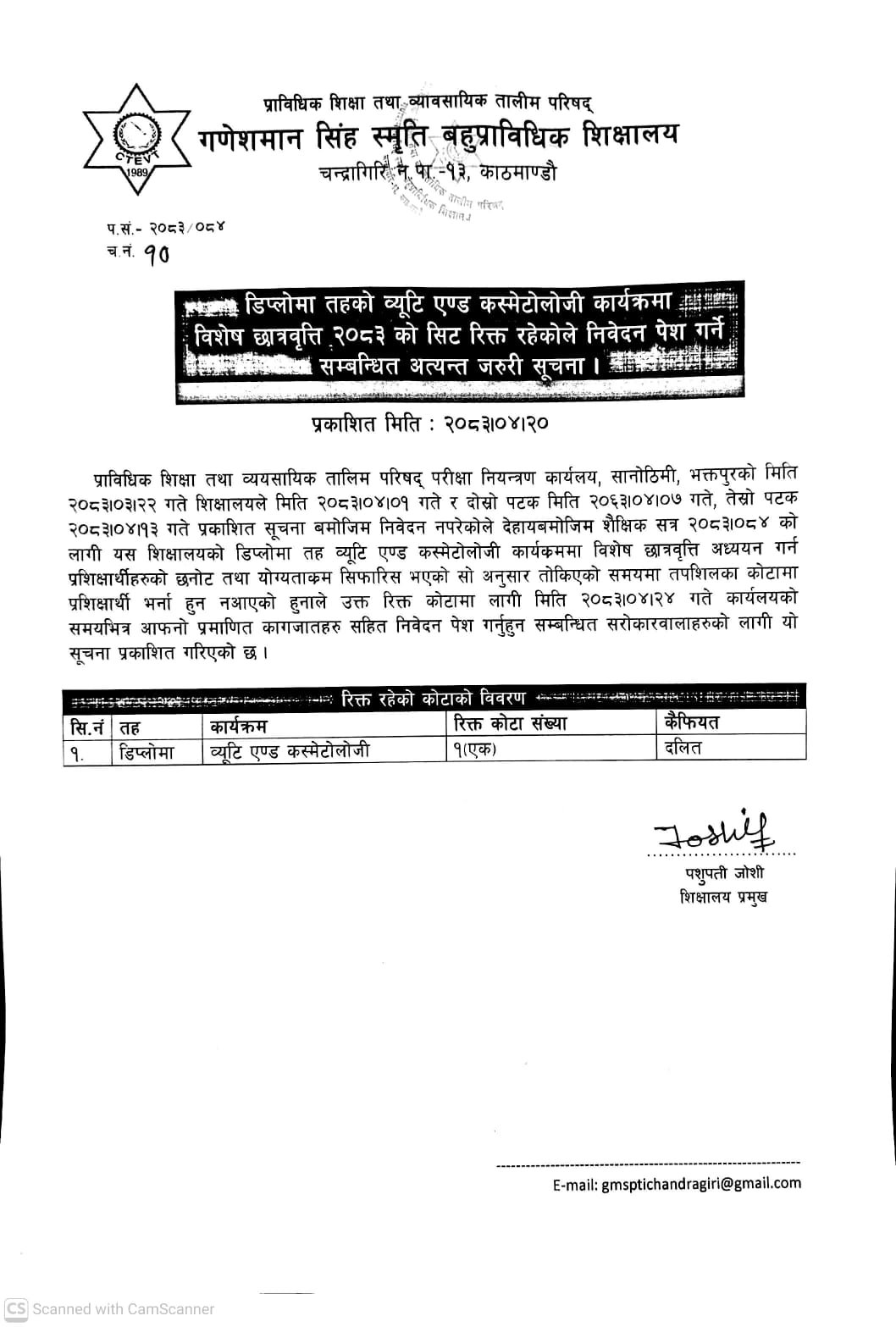
2. Diploma in Beauty and Cosmetology (Animal Science)
3. Diploma in Fashion Design
1. Diploma in Animal Science
Diploma in Animal Science is designed to produce competent
mid-level agriculture technicians capable of performing job
roles required in public and private sectors of agriculture and
community development works in Nepal. The program provides
knowledge, skills, attitudes, beliefs, and values related to
Animal Science, focusing on animal health, husbandry
production, management systems, marketing, and enterprise
development. The curriculum follows a “must know, must do”
approach with detailed subject content to ensure practical
competency and employability. A six- months internship in the
third year enables students to gain workplace-based learning
experience and apply their skills in real-world settings.
The program is structured over three years: the first year focuses
on foundational and basic disciplinary subjects of Animal
Science; the second year emphasizes core disciplinary subjects,
particularly animal health and husbandry production and
management systems; and the third year concentrates on
marketing and enterprise development along with internship
placement.
1. Entry eligibility: SLC/SEE/TSLC passed and overall GPA
grade, or percentage as defined in CTEVT admission
guidelines.
2. Duration: 3 years (yearly) including six months internship
in the third year.
3. Admission criteria: On the basis of merit list in the
entrance examination administered by Council for
Technical Education and Vocational Training (CTEVT).
Allotment of quotas will be as per CTEVT rules.
4. Capacity of enrolment: 40 (Forty)
5. Total course fee NRs.:75,000
Students who successfully complete the course will be awarded
the degree Diploma in Animal Science. Graduates will be
eligible for positions equivalent to Non-Gazetted 1st Class
(Technical) in the agriculture sector as prescribed by the Public
Service Commission of Nepal. They may work as agriculture
technicians in government and non-government organizations,
livestock farms, veterinary service centers, cooperatives, and
agri-based enterprises. Academically, graduates are also eligible
to pursue higher education in bachelor-level programs related to
Agriculture and Animal Science as per prevailing rules.
2. Diploma in Beauty and Cosmetology
Diploma in Beauty and Cosmetology is designed to produce
competent mid-level technical workforce equipped with
knowledge, skills, and professional attitudes in the field of
beauty and cosmetology to meet the growing national and
international market demand. The program prepares graduates to
perform effectively as per the needs of both domestic and global
labor markets. The curriculum focuses on skill enhancement,
practical techniques, and competency development required in
the beauty and wellness sector.
The program is structured over three years, divided into six
semesters, including one semester (six months) of work
experience program. The first year focuses on foundational
subjects such as English, Nepali, Mathematics, and Science to
develop communication skills, academic foundation, and
scientific understanding. It also includes core disciplinary
subjects like fundamentals of beauty and cosmetology, makeup,
nail beautification, hair care, hair treatment, hair chemicals,
facial makeup, and medical-related subjects such as anatomy
and physiology of hair, nail and skin, as well as diet and
nutrition (both theoretical and practical).
The second year emphasizes advanced and in-depth knowledge
of disciplinary and auxiliary subjects including advanced
makeup techniques, nail technology, beautification, hair care
and treatment, hair chemicals, ecology and environment, facial
treatments, dermatological diseases, and cosmeceutical
pharmacology, with both theory and practical components.
The third year focuses on advanced disciplinary subjects and the
practical application of acquired knowledge and skills through a
six-month work experience program in relevant industries and
professional settings.
1. Entry eligibility: SLC/SEE passed and overall GPA,
grade, or percentage as defined in CTEVT admission
guidelines.
2. Duration: 3 years (six semesters) including six months’
Work Experience Program.
3. Admission criteria: On the basis of merit list in the
entrance examination administered by Council for
Technical Education and Vocational Training (CTEVT).
Allotment of quotas will be as per CTEVT rules.
4. Capacity of enrolment: 40 (Forty)
5. Total course fee NRs.: 99,000
Students who successfully complete the course will be awarded
the degree Diploma in Beauty and Cosmetology. Graduates will
be eligible for employment in beauty salons, cosmetic industries,
wellness centers, dermatology clinics, fashion and media
sectors, and as self-employed beauty professionals both within
the country and abroad. Academically, graduates may also
pursue higher-level studies in related fields as per prevailing
rules.
3. Diploma in Fashion Design
Diploma in Fashion Design is designed to produce competent
mid-level technical workforce equipped with knowledge, skills,
and professional attitudes in the field of Fashion Design, Textile,
and Garment to meet the growing national and international
market demand. The program aims to contribute to employment
generation and poverty reduction by preparing skilled human
resources for the fashion and garment industry. Graduates of this
course will be capable of performing fashion designing tasks as
per the needs of both domestic and global markets. While
essential theoretical foundations are incorporated, the
curriculum primarily emphasizes skill enhancement, practical
techniques, and competency development in the concerned
sector.
The program is structured over three years, divided into six
semesters, including one semester (five months) and an
additional three months of Industrial Exposure Programme. The
first year (first and second semesters) focuses on foundational
subjects such as English and Nepali to develop interpersonal
communication skills, along with disciplinary subjects like
Textile, Garment, and Elements of Fashion, both theoretical and
practical.
The second year (third and fourth semesters) emphasizes
disciplinary and auxiliary subjects with greater depth,
integrating both theory and practical components to strengthen
technical proficiency in fashion and garment production.
The third year (fifth and sixth semesters) concentrates on
advanced disciplinary subjects and the practical application of
acquired knowledge and skills through project work and
industrial exposure, preparing students for real-world
professional practice.
Entry eligibility: SLC/SEE passed and overall GPA, grade, or
percentage as defined in CTEVT admission guidelines.
Duration: 3 years (six semesters) including five months
semester and three months Industrial Exposure Programme.
Admission criteria: On the basis of merit list in the entrance
examination administered by Council for Technical Education
and Vocational Training (CTEVT). Allotment of quotas will be
as per CTEVT rules.
Capacity of enrolment: 40 (Forty)
Total course fee NRs.99, 000
Students who successfully complete the course will be awarded
the degree Diploma in Fashion Design. Graduates will be
eligible for employment in fashion houses, textile industries,
garment manufacturing companies, boutiques, export houses,
and as self-employed fashion designers within the country and
abroad. Academically, they may also pursue higher-level studies
in Fashion, Textile, or related fields as per prevailing rules.
About Ganeshman Singh Memorial Polytechnic Institute
(GMSPTI)
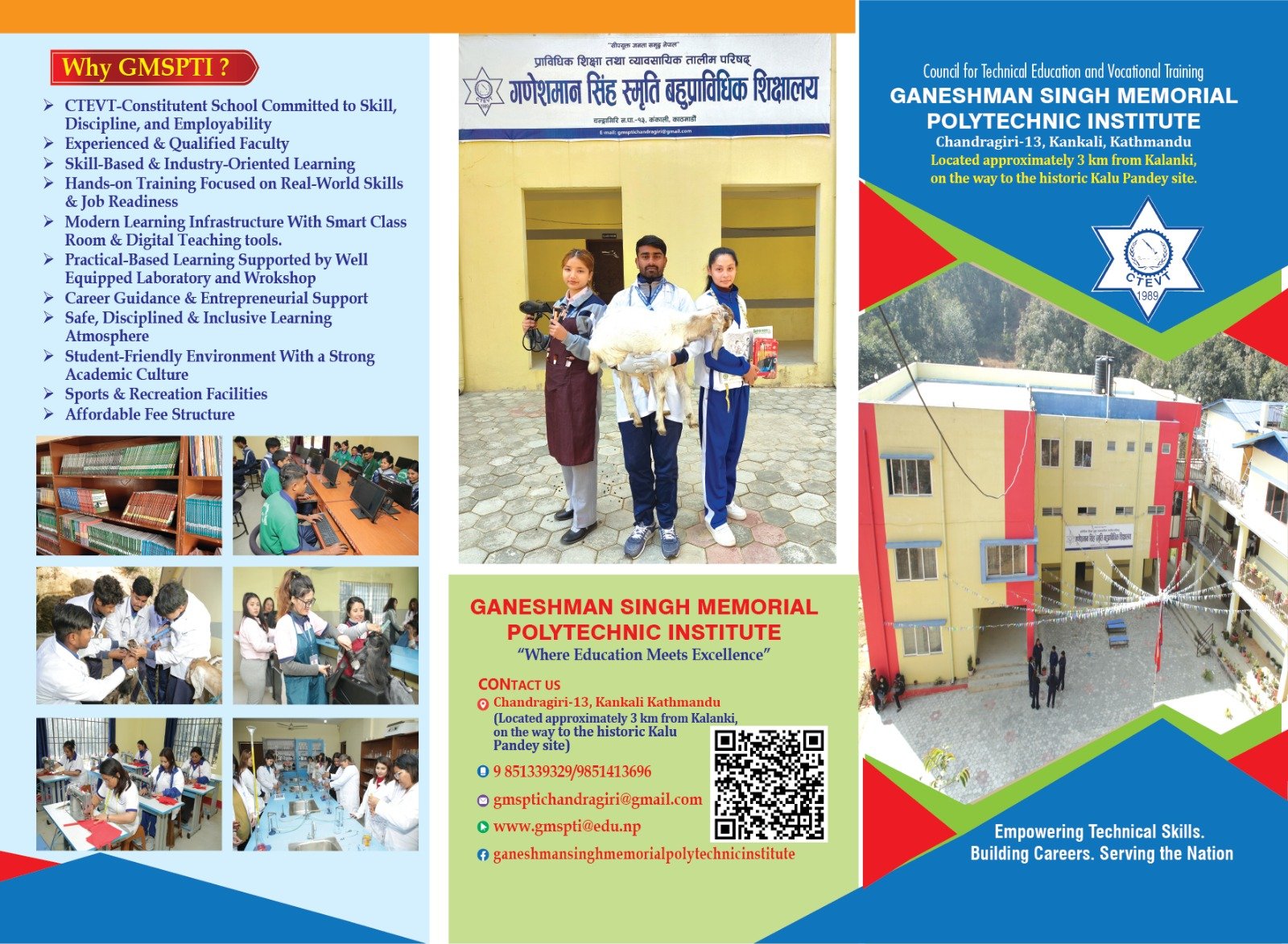
Ganeshman Singh Memorial Polytechnic Institute (GMSPTI) is
a constituent institute of the Council for Technical Education
and Vocational Training (CTEVT), established in 2078 B.S.
with a strong commitment to delivering quality Technical
Education and Vocational Training (TVET) in Nepal.
The institute is located at Chandragiri–13, Kankali, Kathmandu,
approximately 3 kilometers from Kalanki, on the way to the
historic Kalu Pande Smriti Park. Its strategic location provides
convenient access for students while maintaining a peaceful
academic environment.
Named in honor of the revered national leader Ganesh Man
Singh, GMSPTI upholds the values of integrity, dedication, and
service to the nation. The institute strives to create a dynamic
learning environment where students acquire strong theoretical
foundations complemented by extensive practical skills. This
integrated approach ensures graduates are well-prepared to meet
the evolving demands of modern industries and contribute
effectively to the national workforce.
Offered Programs
GMSPTI has progressively expanded its academic offerings to
address the growing demand for skilled technical professionals:
Diploma in Agriculture (Animal Science) – Started from
Academic Year 2079/80
Diploma in Beauty and Cosmetology – Started from
Academic Year 2080/81
Diploma in Fashion Design – Started from Academic Year
2082/83
Through these programs, GMSPTI continues to play a vital role
in producing competent, skilled, and employable graduates who
contribute to national development and economic growth.
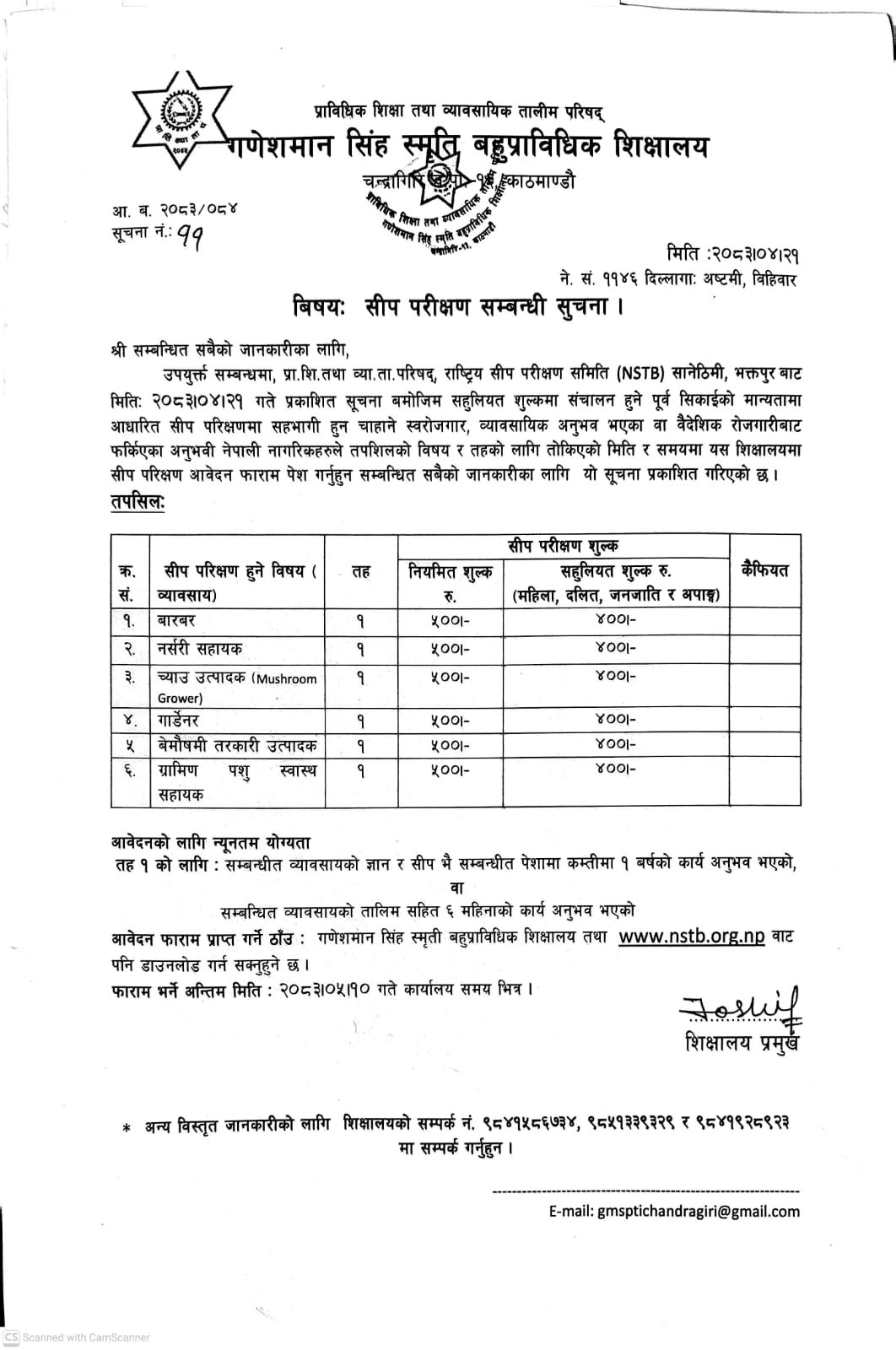
Contract Info
Mobile Number: 9851339329/985413696
Gmail: gmsptichandragiri@gmail.com
Website:www.gmspti@edu.np
Facebook: ganeshmansinghmemorialpolytechnicinstitute
Code of conduct
Code of Conduct for Coordinator
1. The program must be conducted properly according to the institution’s policies, rules,
and objectives.
2. Classes, training, examinations, and evaluations must be managed on time.
3. Equal, respectful, and polite behavior must be maintained with instructors, staff, and
students.
4. The academic quality of Beauty and Cosmetology, Fashion Design, and Agriculture
(Animal Science) programs must be maintained.
5. The student evaluation system must be transparent, fair, and implemented according to
the curriculum.
6. Internal and external evaluation processes must be regularly monitored.
7. Discipline, professional ethics, and a safe environment must be maintained within the
institution.
8. Confidential information, student records, and evaluation results must be kept secure.
9. Priority must be given to trainees’ welfare, safety, and career development.
Code of Conduct for Instructor
1. Classes must be conducted at the scheduled time.
2. Teaching methods must follow the curriculum and learning outcomes.
3. Discipline must be maintained in classrooms, laboratories, salons, workshops, and farms.
4. Student evaluations must be fair, regular, and transparent.
5. Continuous assessment, practical exams, and final exams must be completed on time.
6. Evaluation results must be clearly communicated to students.
7. Equal and fair treatment must be given to all trainees.
8. Safety rules related to Beauty, Fashion, and Animal Science must be strictly followed.
9. Polite language, professional conduct, and positive behavior must be maintained.
10. The institution’s rules, discipline, and reputation must be respected.
Code of Conduct for Students (Trainees)
1. Institutional rules, discipline, and schedules must be followed.
2. Students must attend classes, labs, workshops, and farms on time.
3. Active participation in study, practice, and evaluation is required.
4. Respectful behavior must be shown toward instructors, staff, and fellow students.
5. Honesty must be maintained during evaluations; cheating and misconduct are not
allowed.
6. Tools, materials, and animals related to Beauty, Fashion, and Animal Science must be
used safely and responsibly.
7. Institutional property, cleanliness, and safety rules must be respected.
8. Violence, misconduct, abusive language, and indiscipline must be avoided.
9. Students must manage time properly and develop self-discipline and good character.
10. Students should follow instructors’ suggestions to improve their performance.
Code of Conduct for School Management (Administration,
Accounts, Store)
1. Work must be carried out according to institutional policies, rules, TVET standards, and
management guidelines.
2. Transparency, accountability, and honesty must be maintained in administrative,
financial, and store operations.
3. Proper time management must be maintained in office work, service delivery, and
document handling.
4. Polite and supportive behavior must be shown to students, instructors, parents, and
visitors.
5. Financial transactions, payments, income, expenses, and audits must follow rules and
regulations.
6. Student fees, salaries, allowances, and financial documents must be properly managed
and kept confidential.
7. Equipment, materials, beauty products, fabrics, agriculture tools, and livestock materials
must be stored safely.
8. Records of purchasing, distribution, usage, and stock must be regularly updated.
9. Materials for Beauty, Fashion, and Agriculture (Animal Science) programs must be
properly used for intended purposes.
10. Misuse of institutional property, equipment, and documents must be prevented.
11. Student evaluations, examination records, certificates, and confidential documents must
be securely stored.
12. The institution’s reputation, trust, and professional ethics must be protected.
Code of Conduct for Visitors
1. Visitors must take permission from the concerned authority before entering the
institution.
2. Institutional rules, schedules, and discipline must be respected.
3. A peaceful environment must be maintained without disturbing classes, training, or
evaluations.
4. Visitors must behave politely and respectfully with students, instructors, and staff.
5. Safety rules must be followed in Beauty and Fashion workshops and Animal Science
farms.
6. Unnecessary interference in institutional activities is not allowed.
7. Confidentiality of student evaluations, records, and information must be maintained.
8. Permission must be taken before taking photos, videos, or recording any activities.